
While the Coronavirus pandemic had caused a steep dive in passenger flights – the demand for Cargo planes increases rapidly. This is where IAI’s conversion ability is more valuable than ever
The cancellation of passenger flights across all regions, stemming from the COVID-19 crisis, affected international belly cargo capacity significantly in recent months, according to the IATA Air Cargo Market Analysis for 2020. Overall, international belly cargo capacity has declined by 43.7% in year-on-year terms in March 2020. In contrast to the adverse effect COVID-19 had on commercial aviation services, the demand for dedicated cargo planes has increased under the pandemic, addressing customer’s growing dependence on aerial delivery and online commerce.
As one of the world’s leaders in conversions of wide-body passenger aircraft into cargo planes, IAI has logged new orders in recent months, securing more conversions for its growing international operation.
“Our current main programs in the Conversion & Upgrades business line are the conversion of Boeing 767-300 and B737-700/800 passenger jets into cargo planes,” says Noam Sharoni, Director 767 Cargo Conversions at IAI Aviation Group. “The 767-300 is the right platform at the right time for air cargo. We maintain six conversion lines at Ben Gurion Airport and one line in Mexico, enabling IAI to deliver 18 converted 767-300s and more each year.” Sharoni added.
IAI has recently signed a contract with DHL International GmbH to convert three B767-300 into BDSF cargo configurations, with an option for a fourth aircraft. In 2016 DHL aircraft equipped with Winglets was the first one with that configuration which was converted and certified after a series of testing resulted in a Mod. to the Supplemental Type Certifications (STC) from the FAA, EASA, and CAAI. The original STC was granted in 2009, and after approval of the Mod. in 2016 many other aircraft with Winglets were converted & delivered.
“Since 2015 we redelivered more than 33 aircraft to Amazon Air via our main customer ATSG, most of them 767-300BDSF. Many others are operated by courier, parcel, and express mail providers.” Sharoni said. Established a privately operated air cargo company, Amazon Prime Air has become a major operator of IAI’s 767-300, following the acquisition of 40 planes from ATSG and ATLAS AIR. Both companies turned to IAI to convert their B767-300 into cargo. The program proved successful, as Amazon recently increased its orders and added 12 more aircraft to its fleet, all converted by IAI.
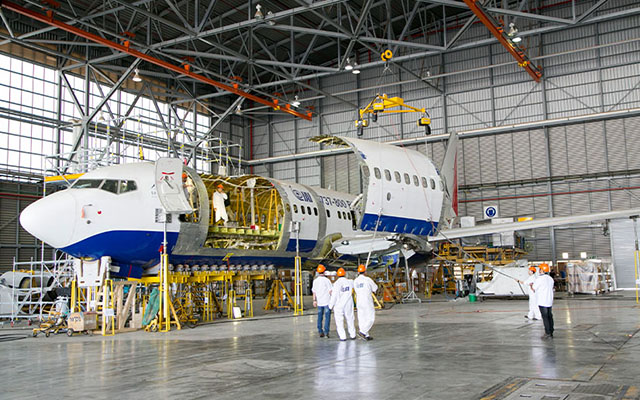
As a leading global provider for aircraft conversions, IAI can develop, certify, produce, test, and deliver narrow, mid, and wide-body aircraft modifications and conversions to meet the market demand and customer needs. Its ability to develop and certify modifications and expand production overseas enables IAI to address the market demand and tap customer needs most conveniently and cost-effectively, regardless of the customer’s location. These technical capabilities and the proven track record in partnering with strong investors and lessors enable IAI to manage those programs as a solid, forward-looking business.
With new-built cargo aircraft costing 10-12 times the price of a converted jet, most players tend to balance their fleets with both. “Giving a second life to a jet aircraft is a matter of a rational business calculation,” Sharoni explained. The feedstock for such conversions is an aircraft with 2-3 decades of operations, having enough flight hours to support decades of operations as cargo planes. “Until now, the market has responded positively to Boeing aircraft, but we also look at Airbus, whether sustainable feedstock is available at favorable terms.”
Forecasts of demand for air cargo predict a need for 1,000-1,500 cargo planes throughout the 2020s decade. While Boeing and Airbus will meet some of the demand with purpose-built cargo planes, preowned passenger jets converted into cargo will provide the lion’s share of this volume, primarily Boeing 737 through 777.
“For the future, we design, develop, and certify the B777-300ER cargo conversion under a joint venture with GECAS. This ‘Big Twin’ promises to become the next big thing in air cargo for its high efficiency, advanced avionics, and large capacity, positioning the 777-Cargo between the 767-300 and 747-400. We expect to receive the STC for this type in 2023 and experience a growing demand for this platform.” Sharoni said.
Until recently, IAI also converted 767-200 and 747-400. While the Jumbo Jet offers a large capacity for outsized cargo, its notorious fuel-guzzling made it unpopular at high fuel costs. The dropping oil price rekindled interest in 747-400 cargo conversions. Today, IAI is the world’s exclusive provider for 747-400 cargo conversion, delivering two such aircraft to customers in 2017.
Among the narrow-body conversion opportunities pursued by IAI is the 737NG, which follows its 737-700 and 737-800 conversion lines currently operating in China and Mexico to address the growing demand.
IAI’s Aviation Group has gained vast experience performing commercial aircraft conversion programs. More than 250 aircraft converted by IAI have accumulated more than two million flying hours after their conversion with high reliability. These assets position the company to meet the increase in demand stemming from the growth in the e-commerce market and the effects of the COVID-19 pandemic.